Developer Advocate CV Guide: Proving You Can Code and Communicate
DevRel is half engineering, half content. Your CV needs to demonstrate depth in both — here's how to structure it.
Developer advocacy is one of the most interesting roles in tech — and one of the most difficult to write a CV for. The challenge is structural. You are a technical professional whose job involves public communication, community building, and content creation, and you are applying for roles where the hiring committee might include an engineering manager, a marketing director, and a community lead, each of whom will read your CV through a completely different lens.
The engineering manager will look for evidence that you can code. The marketing director will look for content reach and audience impact. The community lead will look for evidence you understand developers as a community. Your CV needs to satisfy all three readers without appearing incoherent or diluted.
This guide gives you the specific frameworks to do that.
What Developer Advocacy Actually Encompasses
Before structuring your CV, it is worth being precise about what DevRel roles actually involve, because the scope varies considerably by company and can determine which aspects of your background to foreground.
At a small startup or API company, developer advocacy is often highly technical: you are writing production-quality sample code, building integrations, maintaining SDKs, and providing detailed technical feedback to the product team based on developer conversations. The community and content work is real, but the technical credibility is foundational.
At a larger platform company, the role may be more stratified. You might specialize in content (technical blog posts, conference talks, YouTube tutorials) or community (Discord, forums, developer events), with less expectation that you are writing production code daily. The engineering floor is lower, but the communication and reach expectations are higher.
At an enterprise SaaS company, developer advocacy often functions closer to a technical sales engineer or solutions architect role, with community and content as secondary channels. The emphasis is on enabling enterprise developers to succeed with the product.
Knowing which type of role you are applying for shapes everything about how you write your CV.
The Structure That Works
Developer advocacy CVs work best with a structure that surfaces both dimensions explicitly rather than trying to blend them. Here is the layout that consistently performs:
Professional summary — 3–4 sentences. Establish clearly that you are a technical professional who specializes in developer education and community. Something like: "Developer advocate with a background in full-stack engineering and four years of experience building developer communities, creating technical content, and enabling developers through SDK contributions and sample applications." Note the order: technical credibility first, communication skills second. This is not incidental — in most DevRel hiring decisions, the technical bar is the harder one to clear.
Technical skills — list languages, frameworks, platforms, and tools. Be honest about depth. "Proficient in Python and JavaScript" means something different from "casual familiarity with multiple languages." Hiring managers in DevRel are developers themselves and will probe during the technical screen.
Content and community reach — this is a section many candidates omit, and that omission is a mistake. Developer advocacy is partly a distribution job. If you have a developer blog with meaningful traffic, a YouTube channel, conference talk recordings, open source contributions with stars or forks, or a community you have helped grow — list it. Quantify it.
Work experience — detailed below.
Speaking and publications — a separate section for significant talks, articles, tutorials, podcast appearances, or workshops. This does not need to be exhaustive; three to five high-signal items beat a long list of minor mentions.
Writing Work Experience for DevRel Roles
The work experience section of a developer advocacy CV requires a different rhythm from a pure engineering CV. You are not writing a list of technical achievements. You are writing a story of technical credibility plus developer impact. Each role should have bullets across both dimensions.
A few examples of how this looks in practice:
Weak: "Created technical blog content for developer audience"
Stronger: "Wrote 24 technical articles in 12 months on [Platform] best practices, averaging 8,000 views per post and cited in the documentation of three third-party integrations"
Weak: "Contributed to SDK and sample code"
Stronger: "Owned the Python SDK — triaged issues, merged 60+ community PRs, and reduced average issue resolution time from 11 days to 3 — resulting in a 40% increase in SDK GitHub stars over six months"
Weak: "Spoke at developer events"
Stronger: "Delivered 12 talks at events including DevRelCon, PyCon, and internal developer summits; average post-talk workshop registration rate of 34%"
Weak: "Supported developer community on Discord"
Stronger: "Grew Discord community from 800 to 4,200 active members over 18 months; implemented onboarding flow and community health metrics that reduced 90-day churn by 28%"
The pattern is consistent: claim plus mechanism plus measurable outcome. In DevRel specifically, the mechanism often involves both a technical element (you built something, improved something, wrote something with code) and a community or distribution element (people found it, used it, shared it, returned to it).

Demonstrating Technical Credibility: The Non-Negotiables
For a developer advocacy role at a company with a meaningful developer product — an API, a platform, an infrastructure tool — technical credibility is not optional. Here is what the evidence needs to look like.
Code samples that are public and findable. Your GitHub profile will be checked. It needs to have repositories with actual code, meaningful commit history, and ideally contributions to other projects. A GitHub profile that contains five empty repositories and a fork from 2019 is actively harmful. If you have contributed to open source projects, even modestly, list the specific repositories and what you contributed.
Sample applications that are genuinely instructional. The best developer advocates build things that other developers learn from. If you have built tutorial apps, starter templates, or integration guides that are live and used, link to them. Even one well-constructed example application demonstrates more than a page of self-description.
Technical writing that requires code knowledge. Blog posts or documentation you have written that involve code snippets, architectural explanations, or debugging walkthroughs are strong evidence. Articles that talk about technology in general terms without code are weaker signals.
Feedback loops with product teams. Developer advocacy has an internal function: surfacing developer pain points to the product team in a way that influences the roadmap. If you can demonstrate that your feedback led to specific product improvements, this is extremely compelling evidence that you were operating as a strategic asset rather than just a content creator.
Building Your Portfolio Before You Apply
If you are transitioning into developer advocacy from a pure engineering role, or if you are early in your DevRel career, the portfolio work you do before applying matters enormously. Here are the highest-leverage investments.
Start writing publicly. A personal blog or a series of articles on a platform like Hashnode, dev.to, or Substack that teaches something technical builds your reputation and your archive simultaneously. After six months of consistent publishing, you have evidence of sustained output that no CV bullet point can replicate.
Speak at a local meetup. Developer conferences are competitive, but local developer meetups are almost always open to new speakers. One or two talks gives you a real bullet point and a recording if you arrange to have it captured.
Contribute to an open source project you use. Even documentation improvements, bug fixes, or reproductions of reported issues count. Pick something you genuinely use and care about. Your contributions will be more coherent and your knowledge deeper when asked about them in an interview.
Build one genuinely useful sample application. Not a tutorial you followed — something you built to solve a real problem or to demonstrate something you wished was better documented. This single project, if it is good, can anchor your entire portfolio narrative.
Much of this advice transfers — the Content Writer CV guide and the AWS CV guide show how it plays out elsewhere.
Content and Community Metrics: What to Track
Developer advocacy hiring managers want to see evidence that your work drives developer adoption and engagement. The metrics that matter most are not always obvious.
Developer-specific engagement metrics matter more than vanity metrics. 500 developers attending a talk matters more than 10,000 video views. 200 developers completing a workshop matters more than 2,000 blog page views. Reach in a non-developer audience does not transfer.
Conversion and activation metrics are highly compelling. If you can demonstrate that a tutorial you wrote converted readers into free trial signups, or that a workshop you ran led to measurable increases in API usage, you are demonstrating exactly what developer advocacy is supposed to accomplish.
Community health metrics — active member growth, retention rates, response times, sentiment indicators — are increasingly important as companies invest more in developer communities as a retention and loyalty channel.
If you do not have formal access to these numbers from your current or previous role, do your best to reconstruct reasonable estimates based on what you do know and be transparent about the estimation methodology when asked.
Positioning Yourself Against Pure Engineers and Pure Marketers
The developer advocacy hiring process often involves a technical screen and a communication assessment, sometimes with a take-home exercise that involves both. The candidates who typically lose are those who are excellent at one dimension but unconvincing at the other.
Pure engineers who enter DevRel sometimes fail the communication assessment — they can build impressive things but struggle to articulate why a developer should care about them, or produce content that is technically accurate but pedagogically impenetrable.
Marketers with surface-level technical knowledge sometimes fail the technical screen — they cannot write meaningful code or answer questions about the product at the implementation level, and developers in the community eventually sense that they are being supported by someone who cannot actually help.
The sweet spot your CV needs to communicate is genuine technical competence that is channeled through a teaching and community mindset. You build things because you understand how they work; you explain things because you want other developers to understand them too. Both halves are real. Both halves are deep.
Tailoring Your CV for the Specific Role
Developer advocacy job descriptions vary enormously. Some emphasize conference speaking. Others emphasize SDK maintenance. Others are almost entirely community management with a technical prerequisite. Reading the job description carefully and tailoring your CV to match the specific emphasis is especially important in this field.
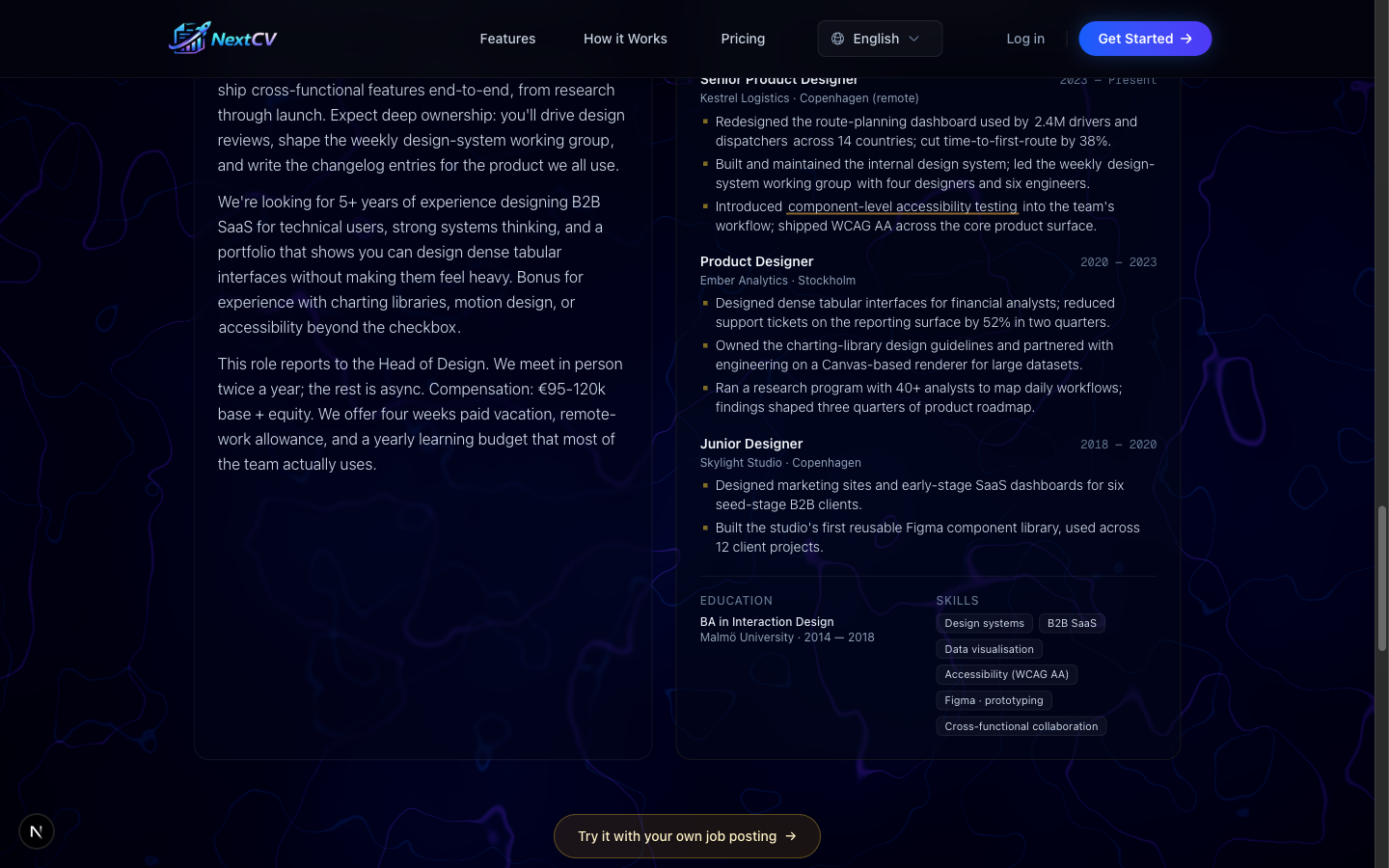
A tool like NextCV makes it practical to generate a version of your CV that surfaces the most relevant experience for each specific role. Given that the same underlying background can support multiple different framings, this kind of tailoring is the difference between a CV that resonates immediately and one that reads as generic.
The Interview: What to Prepare
Developer advocacy interviews typically include at least one of the following components: a live coding exercise or code review, a presentation or mock talk on a technical topic, and a discussion of your content strategy and community philosophy. Being excellent at all three requires sustained preparation — not cramming.
The candidates who land DevRel roles are those who have been doing the work before the interview: publishing content, speaking at events, contributing to communities. The interview is an opportunity to surface a body of work that already exists, not to manufacture one under pressure. Start building it now, and let the CV be the document that points to it.
Ready to put this into practice? Build your Developer Advocate CV with NextCV →
For the wider context, the frontend guide (performance, accessibility, and framework signals) and the guide for DevOps engineers (pipelines, reliability numbers, and IaC depth) are the natural next stops. Worth a skim before you finalise anything: the guide for freelancers going permanent, on presenting self-employed work without looking scattered.
Related Articles
- The Best CV Format in 2026: Chronological, Functional, or Hybrid?
- TypeScript on Your CV: How to Showcase It So Employers Actually Notice
- React on Your CV: How to Showcase It So Employers Actually Notice
- Python on Your CV: How to Showcase It So Employers Actually Notice
- Full Stack Developer CV Guide: What Recruiters Actually Look For in 2026