How to Reach Out to Recruiters: Messages That Get Responses
Cold messages to recruiters usually fail because they ask for favors instead of offering value. Here's what actually works.
Most cold messages to recruiters go unanswered — not because recruiters are rude, but because the messages they receive are, almost universally, variations on the same request: please help me find a job. That is not a message worth responding to. It describes your need, not a reason for them to spend five minutes of a packed day engaging with a stranger.
The recruiters who do respond to cold outreach are responding to something different: a message that is specific, relevant, and easy to act on. Getting that formula right takes a small investment of research and a significant shift in how you frame your ask. This guide breaks down exactly what that looks like — including word-for-word templates you can adapt.
Why Recruiters Ignore Most Cold Messages
Before the templates, it helps to understand the inbox you are sending into. A recruiter at a mid-sized tech company or a busy agency is processing hundreds of messages per week — LinkedIn requests, InMail, emails forwarded through job boards, and direct applications all arriving in parallel. They are not reading carefully. They are scanning for signals.
The signals that make a message worth opening are: does this person understand what I actually place? Is their background relevant to roles I am currently filling? Is this going to take me more than thirty seconds to process?
Messages that fail these tests in the first two lines get archived. Messages that feel like form letters — even well-written form letters — get archived faster. And messages that are long, unfocused, or vague about what the sender wants get archived before the recruiter reaches the actual request.
This is not cynical. It is a function of volume and time constraints. Understanding it reframes your task: you are not writing a career summary, you are writing something that clears a three-second screen.
The Four-Part Formula for a Message That Gets Read
Effective cold outreach to a recruiter follows a structure that can be summarized as: relevance, specificity, value signal, single ask.
Relevance means establishing immediately that you understand what this recruiter works on. "I noticed you specialize in placing product managers in fintech" is relevant. "I am interested in exploring new opportunities" is not.
Specificity means being exact about who you are and what you are looking for. "I am a senior backend engineer with six years in distributed systems, currently looking for a staff-level role at a Series B or C company" gives a recruiter everything they need to know if you are in their current inventory. "I have experience in technology" does not.
Value signal means giving the recruiter a quick reason to believe you are placeable. This is not a full career story — it is one line that demonstrates your ceiling: a company they recognize, a result they can use in a pitch, a credential that places you in a category. "Previously at Stripe" or "shipped a product that reached 2 million users" tells a story instantly.
Single ask means ending with one clear, easy request — not "let's explore opportunities" (vague), not "please review my CV and let me know if there is anything suitable" (effortful). Instead: "Would you be open to a brief call to see if there's a match?" or "Are there any roles open at the moment that might fit?" One question. One decision. Easy to answer yes or no.
Researching Before You Write: The Two Minutes That Change Everything
The difference between a message that converts and one that doesn't is almost always the research that happened before writing. Before you contact any recruiter, spend two minutes answering three questions.
First, what do they actually place? Most recruiters on LinkedIn list their specializations explicitly. If they work in life sciences and you are a software engineer, your message is irrelevant regardless of how well it is written.
Second, what companies do they work with? Recruiter profiles often reveal their client base through recent posts, their bio, or the companies of their connections. If you can reference one specifically — "I saw that you work with companies like X" — the message immediately reads as targeted rather than broadcast.
Third, are they currently active? A recruiter who posted yesterday about an open senior role is infinitely more likely to respond to a relevant candidate than one who has not been active on LinkedIn for months. Active recruiters have live mandates. Dormant ones may not.
This research does not need to take long. It just needs to happen before your fingers touch the keyboard.

The Templates: Adapted for Different Scenarios
Template 1: Reaching out when they have posted a role you did not formally apply to
Subject: [Job Title] — relevant background worth sharing?
Hi [Name],
I came across your post about the [Job Title] opening at [Company] and wanted to reach out directly before submitting through the formal process. I am a [your title] with [X years] of experience in [specific area], most recently at [Company where you built relevant experience]. [One sentence on a relevant achievement or credential.]
If it would be useful, I am happy to share my CV. Happy to jump on a 15-minute call if that is easier.
[Your name]
Template 2: Cold outreach to an agency recruiter in your space
Subject: [Your role/specialism] — worth keeping on file?
Hi [Name],
I came across your profile and noticed you work with [type of company / sector]. I am currently exploring my next move and wanted to reach out in case there is a fit with any of your current or upcoming mandates.
Background: I am a [title] with [X years] in [specialism]. Previously at [notable company or project]. Currently looking for [specific role/level] ideally at [type of company].
If that matches anything you are working on, I would welcome a brief call. And if the timing is not right, I am happy to be kept in mind for future searches.
[Your name]
Template 3: Reaching out to an internal recruiter at a company you want to join
Subject: [Your specialism] — interest in [Company]
Hi [Name],
I have been following [Company] for a while — particularly the work your team has been doing on [specific product area or recent announcement]. I am a [title] with [X years] experience in [relevant area] and am genuinely interested in joining the team.
I do not see a directly relevant opening right now, but wanted to introduce myself in case something comes up or in case there is a role not yet posted. Happy to share my CV and chat briefly if useful.
[Your name]
Timing and Channel: Where and When to Send
LinkedIn InMail has a higher open rate than cold email for most recruiters because it is contextually relevant — you are a professional messaging a professional on a professional network. For agency recruiters, email can also work if you can find a direct address. Do not use both channels simultaneously on the same message; it looks desperate and creates confusion about where to respond.
Morning messages on weekdays perform better than Friday afternoon or Sunday night messages, not for mystical reasons but because recruiters are in active mode earlier in the week. Tuesday and Wednesday mornings see the highest recruiter engagement on LinkedIn. This is a marginal advantage, but marginal advantages compound.
Follow up once — and only once — if you hear nothing after a week. A single short follow-up is professional. Two follow-ups without a response is a signal to move on.
What to Do When They Respond
When a recruiter responds positively, your job shifts to one thing: being easy to deal with. Respond quickly. Have a current CV ready. Be clear about your parameters — compensation, location, notice period, what you will and will not consider. Vagueness at this stage wastes both parties' time and makes you seem unprepared.
If the call surfaces roles that are not quite right, end it well anyway. Say clearly that this particular role is not the right fit, explain briefly why, and thank them for their time. Recruiters have long memories for candidates who are professional even when they say no. The one who handled the rejection gracefully is the one who gets called when the right role appears six months later.
Building Your CV Before the Call
A recruiter who responds to your message will almost certainly ask for your CV. This is not the time to send a generic document you last updated two years ago. The CV you send to a recruiter should reflect the type of role you told them you are looking for — if you pitched yourself as a product-focused engineering leader, your CV needs to substantiate that framing clearly.
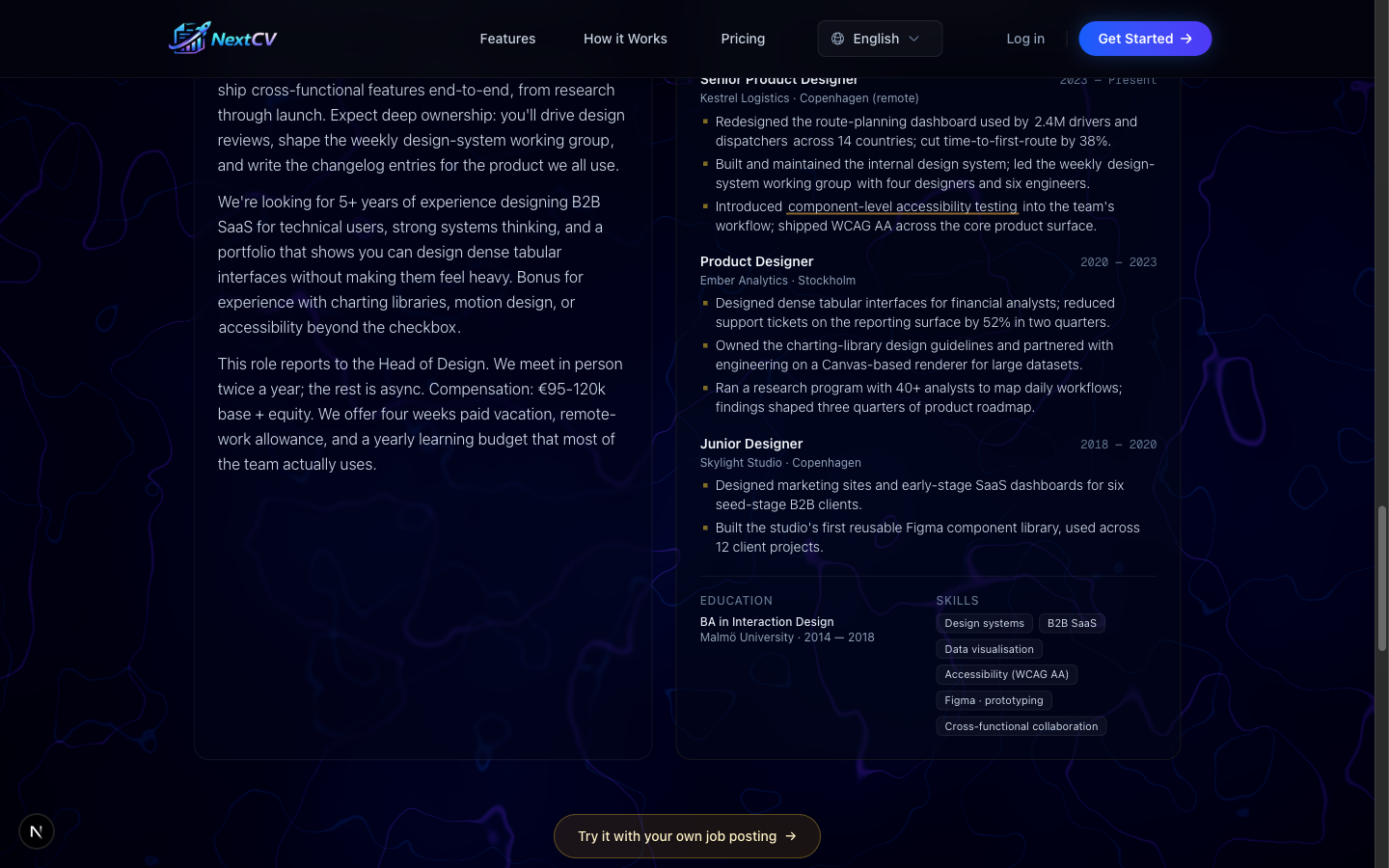
Tools like NextCV make it straightforward to generate a tailored version of your CV against a specific role or profile before you send it. The recruiter receiving a well-matched document is far more likely to take the next step than one who receives something vague and broad and has to do the matching work themselves.
The Longer Game: Staying Visible Without Being Annoying
Recruiter relationships that pay off are rarely transactional. They develop over time through a combination of professional behaviour, relevant signal, and occasional low-stakes contact. If a recruiter placed you, reach back out in a year to let them know how it went — this is extraordinarily rare behaviour and it builds lasting goodwill.
If a recruiter did not place you but stayed professional throughout a search that didn't pan out, stay connected on LinkedIn. Comment thoughtfully on relevant posts. Share insights that demonstrate your expertise. Being present in their feed without asking for anything positions you well for when they have a role that genuinely fits.
Cold outreach is where the relationship starts. Consistent professional presence is what turns a one-time contact into someone who thinks of you first when the right thing opens up.