HR Manager Interview: They Know All the Tricks — Here's How to Still Impress
Interviewing for an HR role means being evaluated by experts in interviewing. Here's how to demonstrate people skills and strategic thinking.
Interviewing for an HR manager role is one of the more uniquely pressured experiences in the job market. You are walking into a room — or joining a video call — where the person evaluating you has spent years running precisely this kind of conversation. They know the standard answers to every competency question. They have seen the STAR method executed a thousand times. They know when you are performing and when you are genuine.
That does not make the interview impossible to do well in. It makes the margin between a great candidate and an average one unusually visible. This guide gives you a clear picture of what excellent looks like and how to achieve it.
What HR Interviewers Are Actually Evaluating
Before diving into specific question types, it helps to understand the evaluative frame that experienced HR interviewers bring to the table. They are not primarily checking whether you know HR theory — they can assume you do. They are assessing three things that are much harder to fake.
Genuine self-awareness. HR managers handle difficult conversations, performance issues, and organizational conflict. The interviewer wants to know that you have enough self-awareness to recognize your own biases, your gaps, your failure modes. Candidates who present themselves as flawless are either oblivious or dishonest. Either way, they are not who you want managing people.
Practical wisdom under ambiguity. HR work is full of situations with no clean answer: competing interests, legal grey areas, a business case and a people case that pull in opposite directions. The interviewer wants to see how you think through complexity, not just whether you arrive at the "right" answer.
Credibility as a business partner. Modern HR is expected to sit at the strategy table, not just administer processes. Interviewers are assessing whether you understand business context, whether you can articulate the commercial impact of people decisions, and whether you will add value to a leadership team beyond compliance and administration.
Keep these three threads running through everything you say. They are the evaluation, even when the explicit question is about a competency or a behaviour.
The Competency Questions: How to Do Better Than the Standard Format
Behavioural or competency-based questions — "Tell me about a time when..." — are standard in HR interviews. The STAR format (Situation, Task, Action, Result) is sound structural advice, but the problem is that every prepared candidate uses it and the resulting answers can sound identical. Here is how to make your STAR answers genuinely stand out.
Start with the outcome. Instead of building chronologically to your result, lead with it. "I resolved a conflict that had been escalating between two senior team members for three months, and both of them remained in their roles and are now collaborating productively." You have immediately established that the story ends well and that the stakes were high. Now the interviewer wants to know how.
Be specific about what was hard. Generic STAR answers describe what happened. Strong STAR answers acknowledge what made the situation genuinely difficult — the competing loyalties, the incomplete information, the cultural constraints, the pressure from above. This specificity is what makes the interviewer believe the story is real.
Reflect on what you would do differently. After the result, add one sentence of genuine reflection: "Looking back, I would have involved the manager's direct reports earlier — I underestimated how much the team dynamic had been affected." This is not weakness. This is the self-awareness signal that separates strong HR candidates from those who have learned to narrate their successes without learning from them.
The Questions That Reveal Strategic Thinking
The questions that separate HR manager candidates are not the behavioural ones — they are the ones that invite you to demonstrate business partnering capability and strategic judgment.
"How do you balance the needs of the employee with the needs of the business?"
The honest answer is that you do not always reconcile them — you navigate the tension with context and judgment. A strong response acknowledges the genuine conflict, describes the factors you weigh (legal exposure, precedent, team morale, manager credibility, business urgency), and uses a real example where you made a call that was right for the business even when it was hard for the individual. Avoid platitudes about always finding a "win-win" — experienced interviewers know that is not always possible and will be less impressed by candidates who pretend otherwise.
"What metrics do you use to measure HR effectiveness?"
This is a business partnering question in disguise. The answer an average candidate gives: turnover rate, time-to-hire, eNPS. The answer a strong candidate gives includes those but goes further: the quality of hire metric and what it actually measures, the relationship between retention rates in high-performing versus low-performing cohorts, the correlation between manager effectiveness scores and team-level attrition, the cost per hire versus external benchmark. You are demonstrating that you understand HR outcomes in commercial terms, not just operational ones.
"Tell me about a time you challenged a senior leader on a people decision."
This is where many candidates either fabricate a conflict that was more minor than they describe, or avoid the real story because it involves something uncomfortable. The interviewers want the real story. A genuine example of pushing back on a manager or executive, explaining your reasoning, navigating the power dynamic professionally, and either influencing the outcome or handling being overruled with integrity — that is gold. If you have never done this, you need to ask yourself whether you have genuinely operated as a business partner or primarily as an administrator.

Demonstrating Employment Law Knowledge Without Sounding Like a Textbook
HR managers need strong employment law knowledge, but interviewers are not looking for a legal recitation — they are looking for candidates who understand how legal risk intersects with people decisions and who can navigate that intersection without either ignoring it or becoming paralyzed by it.
When legal knowledge is relevant to an answer, deploy it conversationally rather than in list form. "I was aware that the situation had potential constructive dismissal exposure, so I made sure we were documenting the support offered and the performance improvement process carefully before any conversations about separation happened." This signals legal literacy while demonstrating that it informed a practical decision, not just a theoretical concern.
Avoid beginning answers with legal disclaimers. "Well, it depends on the jurisdiction and the applicable employment law in that context" is a real thing to say but it is rarely the right opening to a competency question. Lead with the practical judgment; integrate the legal awareness.
The Questions They Will Expect You to Ask
The quality of the questions you ask in an HR interview is evaluated more critically than in most other roles. You are demonstrating your professional judgment in real time. Here are the categories of questions that land well.
Questions about the specific HR challenges the organization faces. "What is the biggest people-related challenge facing the leadership team right now?" or "What made you decide to hire for this role at this point in time?" These questions signal strategic interest and give you information that helps you understand the real context of the role.
Questions about how HR is perceived in the organization. "How does the leadership team engage with HR? Would you describe the function as primarily operational or strategic at this point?" This is a direct probe into how much influence you would actually have in the role — essential information if you are considering a move.
Questions about team and support structure. "What does the HR team look like? What would I be inheriting in terms of processes, systems, and existing team relationships?" This demonstrates that you are thinking practically about what it would take to be successful, not just whether you want the role.
Questions about success criteria. "What would success look like in the first six months? What would the business be noticeably better at because of someone in this role?" This is a direct business partnering question — it shows you think in terms of outcomes, not activities.
Avoid questions that are primarily about compensation and benefits at this stage, questions that can be answered by reading the job description, and questions that begin with "I know you've probably heard this before, but..."
Demonstrating Emotional Intelligence in Real Time
HR interviews assess emotional intelligence as a live skill, not just a claimed attribute. Everything about how you conduct yourself in the interview is evidence: how you handle a challenging question, how you respond to disagreement, how you talk about former colleagues, employers, and difficult situations.
The most common failure mode is talking negatively about former employers, managers, or colleagues. Experienced HR interviewers are watching this closely. If you describe a toxic leadership team, an impossible manager, or a dysfunctional culture, the most interesting question they are silently asking is: what was your role in that dynamic? How did you navigate it? What did you learn?
Frame difficult experiences as professional learning rather than character indictments. Not "my manager was completely undermining everything HR was trying to do" but "I was in an environment where HR didn't have the credibility with the business that it needed, and that taught me a lot about how to earn that credibility earlier in the relationship."
This is not dishonesty. It is the demonstration of the same emotional regulation and reframing skill you would use in a difficult employee conversation — and the interviewer will notice the parallel.
The Preparation Workflow
Given the evaluative sophistication of HR interviewers, your preparation needs to go deeper than reviewing standard competency questions.
Research the company's people challenges: look at Glassdoor reviews, recent LinkedIn activity from the HR team, any public statements about culture or workforce strategy. Go into the interview already knowing something real about what the company is wrestling with.
Prepare five or six strong STAR stories that cover: a complex employee relations case, a time you influenced a business decision with people data, a time you managed through significant organizational change, a time you challenged a leader, and a time you had to handle a situation where you did not know the answer immediately and had to work through it. Practise delivering these conversationally, not as polished speeches.
Review your own HR philosophy. Questions like "what is your HR leadership style" or "how do you approach the HR business partner model" are not trick questions — they are invitations to articulate a coherent professional worldview. Know yours before you walk in.
Making Your CV Work Before the Interview Happens
Everything above assumes you have made it to the interview stage. Getting there from an HR manager application requires a CV that demonstrates the strategic HR capability, not just operational experience.
The strongest HR manager CVs lead with business impact: retention improvements, time-to-hire reductions, DEI metric movements, culture scores. They demonstrate scale (number of employees supported, number of hiring rounds managed, size of org change projects handled) and show strategic partnership (board-level reporting, leadership team coaching, M&A people workstreams). They use the language of business outcomes, not HR activities.
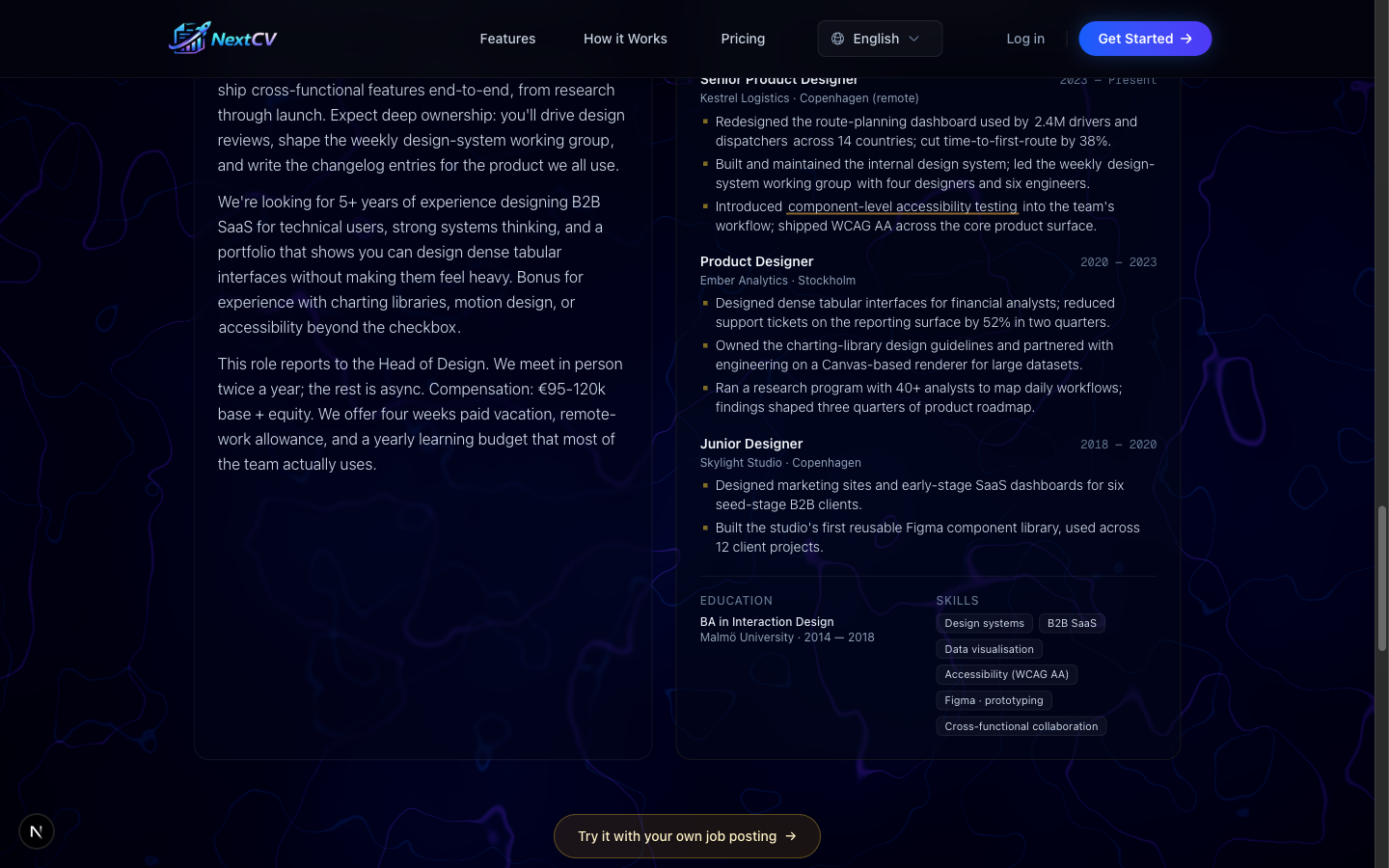
Tools like NextCV make it practical to tailor your CV to each specific role — emphasizing the strategic capability for a generalist HR business partner role, or the employment law depth for a complex ER function, or the talent acquisition expertise for a combined HRBP and recruitment mandate. The quality of the match between your CV and the role description determines whether you get the interview in the first place.
The interview is where the real evaluation happens. But you have to earn the right to be evaluated by sending a CV that gets you in the room.
Also see: HR Manager CV Guide: What Recruiters Actually Look For in 2026 — preparing your CV before interviews is essential.
Related Articles
- Software Engineer Interview: The Questions They
- UX Designer Interview: Portfolio Walkthroughs, Design Challenges, and What Judges Want
- Sales Interview Guide: How to Sell Yourself When You Sell for a Living
- Project Manager Interview Questions: Methodology, Stakeholders, and Real Scenarios
- Product Manager Interview Guide: Frameworks That Actually Work