How to Build a Portfolio That Gets You Hired (Even Without Client Work)
No client projects yet? Personal projects, case studies, and side work count — if you present them right.
One of the most common pieces of advice given to people breaking into creative and technical fields is "build a portfolio." The advice is correct. But it usually stops there, without addressing the question that immediately follows: what do you put in it when you do not have client work or employer projects to show?
This paralysis stops more people than it should. The assumption behind it — that a portfolio is a showcase of work done for others, and that work done for yourself does not count — is simply wrong. Hiring managers in design, engineering, product, data, and writing roles know that the best self-directed projects often demonstrate more initiative, more genuine interest, and more original thinking than the third anonymous website built to spec for a client.
The problem is not having personal work. The problem is not knowing how to present it. This guide fixes that.
What a Portfolio Actually Has to Demonstrate
Before deciding what to put in your portfolio, you need to understand what it is being evaluated against. The specific criteria vary by field, but most portfolio reviews are trying to answer the same underlying questions:
Can you do the work? This is the baseline question. Does the work in the portfolio demonstrate the skills required for the role? For a junior UX designer, this means: can you conduct user research, synthesize findings, and produce a clear design that reflects those findings? For a data analyst, it means: can you manipulate real data, apply the right analysis, and communicate what you found?
Can you think through problems? The work itself is evidence of capability, but the thinking behind the work is evidence of judgment. How did you frame the problem? What constraints did you work within? What did you try that did not work? A portfolio that shows process — not just output — is far more compelling than one that shows polished final deliverables alone.
Are you genuinely interested in this field? A portfolio of work that was all done under assignment looks different from a portfolio that includes work done purely out of curiosity. Self-directed work that you built because you wanted to understand something signals genuine intellectual investment in the field.
Can you communicate? How you present your work — in writing, in structure, in the clarity of your case studies — is itself a demonstration of professional communication. A portfolio that is disorganized, poorly written, or assumes the reader already understands your context will undermine otherwise strong work.
Types of Projects That Work Without Client Work
Redesigns of real products. Pick a product you use and have opinions about — an app, a website, a physical product — and solve a real problem with it. Do the full process: document what is wrong, research users if you can, generate multiple approaches, prototype and test a solution. The fact that you were not hired to do this does not make it less valid. It is more credible in some ways — you chose to do it, which means you care about it.
The key requirement: make the problem specific and the solution opinionated. "I redesigned Instagram" is too broad. "I redesigned Instagram's Reels discovery experience to reduce the number of taps to reach relevant content for users who follow fewer than 50 accounts" is a real problem with a real scope.
Dataset analysis projects. For data analysts and data scientists, public datasets are everywhere: government data, Kaggle competitions, academic repositories, sports statistics, financial records, public health data. Download a dataset that genuinely interests you, ask a real question about it, analyze it rigorously, and write up what you found. The writing — turning findings into a clear narrative for a non-specialist — is itself part of the skill demonstration.
Open source contributions. For engineers, contributing to open source is a canonical portfolio builder — but even small contributions count. Fixing a documentation error, resolving a simple bug, or adding a feature to a small project shows that you can work in an existing codebase, navigate a PR process, and communicate technically with strangers.
Personal tools you actually use. Building a tool to solve a problem you actually have is more compelling than building a tutorial app to prove you know a framework. A developer who built their own personal finance tracker because every existing one missed a feature they needed tells a different story than one who built yet another to-do app from a course.
Speculative projects for imagined clients. If you are in design or writing, speculative projects — designing a hypothetical rebrand for a company, writing a content strategy for a startup that does not yet exist — can be strong portfolio pieces if you bring real thinking to them. The key is to be clear that they are speculative and to show the research and reasoning that would make the work coherent if it were real.

How to Write a Portfolio Case Study
The case study is the difference between a portfolio that shows output and a portfolio that demonstrates thinking. Most people only show the output. The case study adds the layer that makes the work legible and makes the thinking visible.
A good case study answers five questions:
What was the problem? Describe the specific problem you were trying to solve, for whom, and why it mattered. Not "I built a weather app" but "I noticed that every weather app I tried either showed too much information for a quick check or required too many taps to get to the information I actually needed for deciding what to wear."
What were the constraints? Every real project has constraints — time, technology, knowledge gaps, available data, competing requirements. Naming the constraints shows that you understand how real work happens and that you made decisions within them, not in a frictionless vacuum.
What did you try? Show your process, including things that did not work. A revised wireframe is evidence that you learned something between iteration one and iteration two. A data analysis that found no significant relationship is a real finding, not a failure. The messy middle is where the thinking happens.
What did you decide and why? Be specific about the choices you made and the reasoning behind them. "I chose X over Y because..." is more valuable than just showing X. The reasoning shows that you have judgment, not just implementation ability.
What would you do differently? Self-reflection demonstrates professional maturity. If you look back at a project and see something you would change, say so. This is not weakness — it is evidence that you have grown since you made the work.
Quality Versus Quantity
A common mistake in portfolio building is trying to show range by including many projects. The result is often a portfolio that shows ten mediocre projects rather than three strong ones.
For most fields, three to five strong, well-documented projects are more effective than ten incomplete or shallow ones. "Strong" means: the work is genuinely competent, the case study clearly explains the problem and the thinking, and the presentation is clean and professional.
If you have existing work that you are not happy with — university projects done quickly, early freelance work that was not your best — you are allowed to not include it. Portfolio curation is itself a skill. Show the work that represents what you can do, not everything you have ever done.
Platform and Presentation
For most fields, the platform matters far less than the work and how it is presented. A clean Notion document, a simple personal site, or a well-organized Behance or GitHub profile can all host an excellent portfolio.
What matters in presentation:
- Loading speed. A portfolio that takes ten seconds to load has already lost a significant number of readers
- Mobile usability. Many portfolio views happen on mobile
- Clear navigation. A reader should be able to find your best work without clicking more than twice
- Legible writing. Case studies should be written at a professional level with correct spelling and grammar
What does not matter as much as you think:
- Whether your portfolio site has custom code or uses a template
- Whether it looks visually impressive for a non-design role
- The number of social proof markers (client logos, testimonials) — these help but are not required
Keeping Your Portfolio Current
A portfolio that is not updated becomes a liability. Hiring managers can tell the difference between recent work and work from several years ago, and a portfolio full of old work raises questions about what you have been doing since.
Build a habit of adding portfolio pieces as you do interesting work — do not wait for a job search to start. When you finish a project at work, a meaningful side project, or an analysis that produced real findings, take thirty minutes to document it in your portfolio format. The documentation is much easier to write when the project is fresh.
Not all your work can be shown publicly due to confidentiality. For work you cannot share in detail, document the problem and your approach in abstract terms — focus on the type of challenge, the methods used, and the outcome category — without revealing proprietary specifics.
The Portfolio and Your CV Working Together
Your portfolio and your CV are two parts of the same application ecosystem. They should reinforce each other but not duplicate.
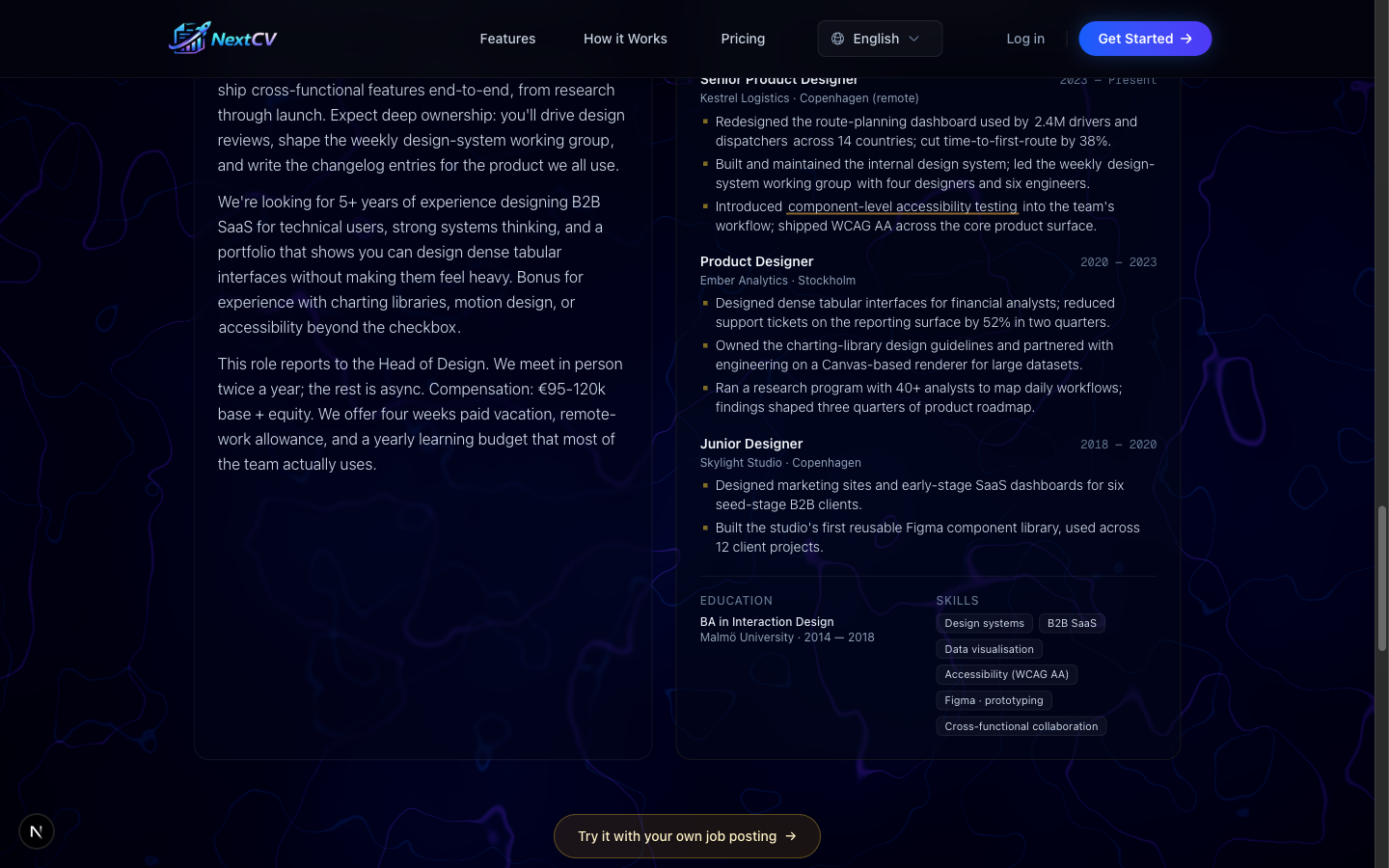
Your CV lists what you did, where, and for how long — the factual record of your career. Your portfolio shows how you think about problems and what the work actually looks like. When they are both strong and coherent, the application adds up to significantly more than either piece alone.
Tools like NextCV can help you build a CV that articulates your experience clearly and tailors it to specific roles — so the written record of your career matches the quality of the work you are showing in your portfolio.
The combination of a strong portfolio and a well-crafted CV is what gets interviews. Neither alone does the full job.
Getting Started When You Have Nothing
If you are truly starting from zero — no work samples, no side projects, no course projects — the answer is to start building today and not wait until you have something "good enough" to show.
Pick one project. Make it small. Give it a real constraint, a specific scope, and a genuine question to answer. Do the full process: research, iteration, output, documentation. That is one portfolio piece. One is infinitely more than zero.
The people who say "I will build my portfolio once I have better skills" are usually the people who still have empty portfolios two years later. The people who build the portfolio before they feel ready are the ones who develop the skills through the building.
Start small. Start now. Document as you go.